Objective Questions indian Sociology
IAS Civil Services objective sociology questions
Free online Solved Questions indian Sociology
1. Who has related the degree of integration of a group with the rate of suicide in a society?
(A) Lowell J. Carr
(B) Cyril Burt
(C) R. K. Merton
(D) Emile Durkheim
2. A change in social position that does not alter a person’s status is called—
(A) Horizontal mobility
(B) Vertical mobility
(C) Structural mobility
(D) Social immobility
3. Who has propounded the concept of Anomie?
(A) Karl Marx
(B) R. K. Merton
(C) Emile Durkheim
(D)Max Weber
4. According to Merton, psychotics, pariahs, out castes, vagrants, vagabonds, tramps, chronic drunkards and drug addicts are—
(A) Conformists
(B) Innovators
(C) Ritualists
(D) Retreatists
5. Who has maintained that fundamental source of social disorganization is Anomie?
(A) R. K. Merton
(B) Talcott Parsons
(C) H. M. Johnson
(D) Emile Durkheim
6. Which one of the following is not the salient feature of social disorganization?
(A) It is conflict between old and new order
(B) it is the outcome of transfer of functions from one group to the other
(C) It is resultant of change in social structure
(D) It is the outcome of a rigid political system
7. Who was propounded the concept of ‘Delinquency Threshold’?
(A) Lowell J. Carr
(B) Helen Witmer
(C) Cyril Burt
(D) Sophia M. Robinson
8. “Rarely is a woman wicked, but when she is, she surpasses the man.” Who has given this statement?
(A) Cesare Lombroso
(B) William Ferrero
(C) Otto Pollok
(D) Walter C. Reckless
9. Who has propounded the labelling theory of deviance?
(A) F. H. Sutherland
(B) Howard S. Becker
(C) David Matza
(D) Marshall B. Clinard
10. Who was the first Chairman of the ‘Backward Classes Commission’ in India?
(A) B. P. Mandal
(B) Kaka Kalelkar
(C) B. R. Ambedkar
(D) M. K. Gandhi
11. Who said that advance from homogeneity to heterogeneity is the universal law of progress?
(A) Auguste Comte
(B) Charles Darwin
(C) E. Durkheim
(D)Herbert Spencer
12. Who said that society is the system in equilibrium?
(A) Max Weber
(B) C. H. Cooley
(C) P. A. Sorokin
(D) V. Pareto
13. Who wrote the book “The Science of Culture”?
(A) B. Malinowski
(B) Tylor
(C) P. A. Sorokin
(D) L. A. White
14. Who among the following is associated with “Diffusional Theory of Development”?
(A) Auguste Comte
(B) Talcott Parsons
(C) McCkleland
(D) Daniel Lerner
15.Who has given Racial Theory of Caste?
(A) Nesfield
(B) Hocart
(C) Herbert Risley
(D) G. S. Ghurye
16. An untouchable getting conve ted to Christianity is an example of?
(A) Political mobility
(B) Social mobility
(C) Horizontal mobility
(D) Vertical mobility
17. Who has written the book ‘Caste in Indian Politics’?
(A) Andre Beteille
(B) T. B. Bottomore
(C) Rajni Kothari
(D) Yogesh Atal
18.The development of the ecological approach to urban analysis is attributed to—
(A) Frankfurt School
(B) Vienna School
(C) Manchester School
(D) Chicago School
19. In which Article of the Consti tution of India the term ‘Back ward Class’ has been used?
(A) 15(4)
(B) 16(4)
(C) 17 (4)
(D) 23 (4)
20.Which one of the following Articles of Indian Constitution talks about grants-in-aid for the welfare of Scheduled Tribes?
(A) 275
(B) 244 (A)
(C) 334
(D) 164(1)
21. In which book Charles, Cooley presented the Theory of Social Control?
(A) Human Nature and Social Order
(B) Sociology
(C) Cultural Sociology
(D) The Social Order
22. Who gave the concept of ‘Consciousness of Kind’?
(A) L. F. Ward
(B) C. H. Cooley
(C) F. H. Giddings
(D) F. Toennies
23. Expulsion of person from his caste for intercaste marriage is an example of—
(A) Positive control
(B) Negative control
(C) Indirect control
(D) Formal control
24. The main aspects of human development are—
1. Life expectancy
2.Literacy percentage
3.Standard of iiving
4. Technological advancement
5. Natural resources
Select the correct answer from the codes given below—
Codes:
(A) l and 2
(B)3 and 4
(C) 1, 2 and 3
(D) 3, 4 and 5
25. Which one of the following is an example of Sanskritization?
(A) Brahma form of marriage among the Namboodiries
(B) Sapta-padi among the Kshatriyas
(C) Sapta-padi among the peasant caste of Karnataka
(D) Monogamy among the present Nayars
Answers:
1 D
2 A
3 C
4 D
5 D
6 B
7 B
8 B
9 B
10 B
11 D
12 D
13 D
14 D
15 D
16 D
17 C
18 D
19 B
20 A
21 A
22 C
23 B
24 A
25 A
Showing posts with label Sociology. Show all posts
Showing posts with label Sociology. Show all posts
Thursday, May 26, 2011

Monday, May 9, 2011
UPSC Civil Services Sociology Free Model paper
UPSC Civil Services Sociology Free Model paper
Sample Questions Sociology for UPSC Civil Services Papers
FREE IAS Exam Preparation - Civil Services Exam : Sociology Practice test
Q. 1. One of the explanations of role is that it is a:
(a) Micro level aspect of status
(b) Static aspect of status
(c) Dynamic aspect of status
(d) Macro aspect of status
Ans. (c)
Q. 2. Which of the following statements associated with status and role are correct?
1. Status is a recognized social position within a society
2. Role. is the behaviour appropriate to a society
3. Role is a guide to status expected from a person
4. Status is ascribed to a person as the person achieves it
Select the correct answer from the codes given below:
(a) 1, 2 and 3
(b) 1, 2 and 4
(c) 1 and 4
(d) 3 and 4
Ans. (c)
Q.3. What is according to Hindu traditional law, marriage by abduction, called?
(a) Gandharva
(b) Paisacha
(c) Arsha
(d) Rakshasa
Ans. (d)
Q.4 Among the muslims, a wife can obtain release from her marriage by giving consideration to husband whose consent is essential. What is this type of divorce called?
(a) Mehar
(b) Tafweez
(c) Khula
(d) Talaq
Ans. (c)
Q. 5. What is a Hindu marriage in which the daughter is gifted to priest, called?
(a) Brahma marriage
(b) Daiva marriage
(c) Sacred marriage
(d) Arsha marriage
Ans. (b)
Q.6. In traditional Hindu society which of the following forms of mate selection were undesirable?
(a) Asura, Rakshasa and Paisacha
(b) Brahma, Asura, Arsha, Gandharva
(c) Rakshasa, Daiva, Prajapatya and Paisacha
(d) Brahma, Arsha and Rakshasa
Ans. (a)
Q. 7. What is cross-cousin marriage practiced by Gonds by Madhya Pradesh called?
(a) Shahadlautwa
(b) Geelaautwa
(c) Pannilautwa
(d) Dudhlautwa
Ans. (d)
Q. 8. “Look after the population and the population will look after itself.” This slogan emerged in World Population Conference held at:
(a) Belgrade
(b) Alma Ata
(c) Bucharest
(d) Cairo
Ans. (d)
Q. 9. Competition has been described as ‘peaceful conflict’ by:
(a) Spencer
(b) Coser
(c) Weber
(d) Frazer
Ans. (b)
Q. 10. Socialization takes place:
(a) during childhood
(b) during young age
(c) during the whole life
(d) at different intervals
Ans. (c)
Q. 11. Match List- I with List -II and select the correct answer by using the codes given below the lists:
List –I List -II
A. Significant others 1. Freud
B. Looking-glass self 2. Cooley
C. Collective representation 3. Mead
D. Id, ego and superego 4. Durkheim
5. Jung
Codes:
A B C D
(a) 2 3 4 1
(b) 4 5 1 3
(c) 3 2 4 1
(d) 3 5 4 2
Ans. (c)
Q. 12. The process by which the group-values are internalized by the individual is called:
(a) assimilation
(b) integration
(c) socialization
(d) accommodation
Ans. (c)
Q. 13. Which of the following are likely to happen to a hitherto dominant culture if there is reaction against acculturation?
1. It will combine the old and the new in a new mosaic
2: It will condemn the cultural degeneration
3. It will defend its heritage
4. It will express its resentment through aggression or phantasy
Select the correct answer from the codes given below:
(a) l, 2 and 3
(b) l, 2 and 4
(c) l, 3 and 4
(d) 2, 3 and 4
Ans. (d)
Q. 14. Which one of the following is not determined by the ‘Rules of Descent’?
(a) One’s consanguineal relations
(b) Inheritance of property
(c) Line of succession
(d) Matrimonial relations
Ans. (d)
Q. 15. Which of the following pairs are properly contrasted?
1. Primogeniture : Ultimo geniture
2. Exogamy : Endogamy
3. Family of orientation : Family of procreation
4. Residually joint family : Potentially joint family
Select the correct answer from the codes given below:
(a) 1, 2 and 3
(b) 1, 3 and 4
(c) 2, 3 and 4
(d) 1, 2, 3 and 4
Ans. (d)
Q. 16. Ceremonies that mark a critical transition in the life of an individual from one phase of life cycle to another are called:
(a) role taking
(b) Rites of passage
(c) status crystallization
(d) status-set
Ans. (b)
Q. 17. A type of marriage known as Levirate is the one that takes place between a man and a:
(a) sister of his deceased wife
(b) widow of his deceased brother
(c) woman of inferior caste
(d) woman of a superior case
Ans. (b)
Q. 18. What is the correct sequence of the following forms of marriage adopted by the Toda tribal people of Nilgiri hills?
1. Monogamy
2. Polygyny
3. Polyandry
Select the correct answer from the codes given below:
(a) 3, 2, 1
(b) 1, 2, 3
(c) 2, 3, 1
(d) 3, 1, 2
Ans. (a)
Q. 19. Which of the following are included in the Family of Orientation?
1. One’s parents
2. One’s spouse
3. One’s siblings
Select the correct answer from the codes given below:
(a) 1, 2 and 3
(b) 1 and 2
(c) 2 and 3
(d) 1 and 3
Ans. (d)
Q. 20. Which one of the following pairs i correctly matched?
(a) Endogamy : Couvade
(b) Baptism : Rites of passage
(c) Kibbutz : Family of procreation
(d) Incest : Religious sacrament
Ans. (b)
Q. 21. The term ‘Status Group was coined by:
(a) Robert Merton
(b) Max Weber
(c) Talcott Parsons
(d) Ralph Linton
Ans. (b)
Q. 22. The system of caste stratification is based on:
(a) rebirth
(b) chaturvarna
(c) varnashrama system
(d) sept
Ans. (c)
Q. 23. The caste system prevented India from going towards barbarianism according to:
(a) Mandelbaum
(b) Dubey
(c) Abbe Dubois
(d) Dumont
Ans. (c)
Q. 24. False consciousness in class stratification is dysfunctional as it obstructs awareness:
(a) of their role in the system
(b) about their demands
(c) of their real status
(d) about themselves
Ans. (a)
Q. 25. Davis and Moore have stimulated a lively and continuing debate in the area of social stratification under the title of:
(a) a functional analysis of stratification
(b) some principles of stratification: a critical analysis
(c) some principles of stratification
(d) dialectical analysis of stratification
Ans. (c)
Q. 26. Observers like Leach and Bailey conclude, basing their views on the ideal principles that caste in India, is essentially.
(a) a non-competitive system
(b) a competitive system
(c) both a competitive and non-competitive system
(d) neither a competitive nor non-competitive system
Ans. (a)
Q. 27. The principal source of ritual pollution is/are:
(a) birth
(b) bodily emissions
(c) death
(d) birth, bodily emissions and death
Ans. (d)
Q. 28. The two stages of ritual purity as described by S.C. Dubey ate:
(a) bodily cleansing and social distance
(b) protracted ablution procedures and initiation rituals
(c) seclusion worship and segregation
(d) formal worship and ceremonies
Ans. (b)
Q. 29. Which of the following statements in relation to class system are correct?
1. A class system may be regarded as a ‘closed system’
2. A class system may be regarded as an ‘open system’
3.. In a class system a person cannot move up and down in the social hierarchy
4. A class system is usually distinguished by social mobility
Select the correct answer from the codes given below:
(a) l and 3
(b) 2 and 3
(c) 1 and 4
(d) 2 and 4
Ans. (d)
Q. 30. Which one of the following- pairs is not correctly matched?
(a) Kathleen Gough : Tanjore
(b) F.G. Bailey : Bisipara
(c) S.C. Dubey : Sripuram
(d) M.N. Srinivas : Rampura
Ans. (c)
Q. 31. The concept of ‘hierarchy’ in the context of caste stratification was given by:
(a) T.N. Madan
(b) Gopala Saran
(c) D.F. Pocock
(d) L. Dumont
Ans. (d)
Q. 32. Match List -I with List- II and select the correct answer by using the codes given below the lists:
List -I (Titles of Books) List –II (Authors)
A. Caste in Modern India 1. A .Beteille
B. Caste, Class, Power 2. L. Dumont
C. Homo Hierarchies 3. R. Kothari
D. Caste in Indian Politics 4. M.N. Srinivas
5. Yogesh Atal
Codes:
A B C D
(a) 4 1 2 3
(b) 3 2 1 5
(c) 1 2 4 3
(d) 5 2 3 1
Ans. (a)
Q. 33. The subsystems of action as developed by Parsons include:
(a) Social system, cultural system and personality system
(b) Social system, political system and cultural system
(c) Cultural system, political system and economic system
(d) Economic system, social system and biological system
Ans. (a)
Q.34. Which of the following characteristics used for defining a law?
l. A rule 2. Justice
3. Political authority 4. State power
Select the correct answer from the codes given below:
(a) 1,2and3
(b) 2 and 4
(c) 1, 3 and 4
(d) 2, 3 and 4
Ans. (c)
Q.35. Which of the following group(s) of factors was/were used by Koreber to classify kinship terminology?
1, Descent, Gender, Polarity, Bifurcation and Lineage
2. Kindred, Class, Affinity, Gender and Polarity
3. Generation, Gender, Affinity, Bifurcation and Polarity
Select the correct answer using the codes given below:
(a) 1 only
(b) 3 only
(c) 2 and 3
(d) 1 and 3
Ans. (c)
Q.36. A special role similar to that of a maternal uncle, for one’s father’s sister is designated as
(a) amitate
(b) couvade
(c) avunculate
(d) teknonymy
Ans. (a)
Q.37.Consider the following statements:
1. Extended family consists of two mates of opposite sex and their offspring
2. Conjugal family consists of two mates of opposite sex and their offspring
3. Consanguineous family consists of two mates of opposite sex and their offspring
Which of the statements given above is correct?
(a) 1 only
(b) 2 only
(c) 3 only
(d) None
Ans(b)
Q.38. When two or more sibs exist in a community, they may be called
(a) moieties
(b) pharteries
(c) exogamous clans
(d) endogamous clans
Ans. (b)
Q.39.Match List-I with List -II and select the correct answer by using the code given below the Lists:
List-I List-II
A. Joking relationships 1 L.H. Morgan
B. Taboo 2. F.J. Pedlar
C. Classificatory terminology 3. E. Durkheim
D. Totemism 4. Sir James Frazer
Codes:
A B C D
(a) 1 4 2 3
(b) 2 3 1 4
(c) 1 3 2 4
(d) 2 4 1 3
Ans. (d)
Q.40. Consider the following statements about family:
1. Family regulates sexual behaviour through incest taboo
2. Family provides ethnic identity
3. Family serves as an occupational guild
4. Family provides predictable social contexts within which its children are to be socialized
Which of the above statements are correct?
(a) 1, 2 and 3
(b) 1, 2 and 4
(c) 1 and 3
(d) 2 and 4
Ans. (b)
Q.41. What is the smallest unit of Tharawad called?
(a) Tavazhi
(b) Nambudiri
(c) Cheri
(d) Koli
Ans. (a)
Q.42.Match List -I with List -II and select the correct answer by using the code given below the Lists:
List-I List-II
(Book) (Author)
A. Urbanism 1. Oscar Lewis
B. Folk urban continuum 2. L. Wirth
C. Little Tradition and Great tradition 3. R. Redfield
D. Culture of Poverty 4. Milton Singer
Codes:
A B C D
(a) 4 1 2 3
(b) 2 3 4 1
(c) 4 3 2 1
(d) 2 1 4 3
Ans. ((b)
Q. 43. Which of the following are likely to happen if a situation is characterized by ethnocentrism?
1. Everything will be measured in the terms of one’s own cultural standard and found wanting
2. Indigenous goods will be regarded as somehow defective
3. Members of other cultures will be less acceptable
4. The traditional beliefs and characteristics of other cultures will be ridiculed
Select the correct answer from the codes given below:
(a) l, 2 and 3
(b) 2, 3 and 4
(c) l, 3 and 4
(d) l, 2 and 4
Ans. (c)
Q. 44. When two cultural groups come in contact with each
other and consequently, in due course of time, one group borrows so heavily from the other that it loses its own identity and gets itself finally absorbed in the other group. This process is known as:
(a) enculturation
(b) socialization
(c) integration
(d) assimilation
Ans. (d)
Q. 45. Which one of the following basic symbols is used for ‘Female’ in constructing a kinship diagram?
(a) □
(b) =
(c) O
(d) ∆
Ans. (d)
Sample Questions Sociology for UPSC Civil Services Papers
FREE IAS Exam Preparation - Civil Services Exam : Sociology Practice test
Q. 1. One of the explanations of role is that it is a:
(a) Micro level aspect of status
(b) Static aspect of status
(c) Dynamic aspect of status
(d) Macro aspect of status
Ans. (c)
Q. 2. Which of the following statements associated with status and role are correct?
1. Status is a recognized social position within a society
2. Role. is the behaviour appropriate to a society
3. Role is a guide to status expected from a person
4. Status is ascribed to a person as the person achieves it
Select the correct answer from the codes given below:
(a) 1, 2 and 3
(b) 1, 2 and 4
(c) 1 and 4
(d) 3 and 4
Ans. (c)
Q.3. What is according to Hindu traditional law, marriage by abduction, called?
(a) Gandharva
(b) Paisacha
(c) Arsha
(d) Rakshasa
Ans. (d)
Q.4 Among the muslims, a wife can obtain release from her marriage by giving consideration to husband whose consent is essential. What is this type of divorce called?
(a) Mehar
(b) Tafweez
(c) Khula
(d) Talaq
Ans. (c)
Q. 5. What is a Hindu marriage in which the daughter is gifted to priest, called?
(a) Brahma marriage
(b) Daiva marriage
(c) Sacred marriage
(d) Arsha marriage
Ans. (b)
Q.6. In traditional Hindu society which of the following forms of mate selection were undesirable?
(a) Asura, Rakshasa and Paisacha
(b) Brahma, Asura, Arsha, Gandharva
(c) Rakshasa, Daiva, Prajapatya and Paisacha
(d) Brahma, Arsha and Rakshasa
Ans. (a)
Q. 7. What is cross-cousin marriage practiced by Gonds by Madhya Pradesh called?
(a) Shahadlautwa
(b) Geelaautwa
(c) Pannilautwa
(d) Dudhlautwa
Ans. (d)
Q. 8. “Look after the population and the population will look after itself.” This slogan emerged in World Population Conference held at:
(a) Belgrade
(b) Alma Ata
(c) Bucharest
(d) Cairo
Ans. (d)
Q. 9. Competition has been described as ‘peaceful conflict’ by:
(a) Spencer
(b) Coser
(c) Weber
(d) Frazer
Ans. (b)
Q. 10. Socialization takes place:
(a) during childhood
(b) during young age
(c) during the whole life
(d) at different intervals
Ans. (c)
Q. 11. Match List- I with List -II and select the correct answer by using the codes given below the lists:
List –I List -II
A. Significant others 1. Freud
B. Looking-glass self 2. Cooley
C. Collective representation 3. Mead
D. Id, ego and superego 4. Durkheim
5. Jung
Codes:
A B C D
(a) 2 3 4 1
(b) 4 5 1 3
(c) 3 2 4 1
(d) 3 5 4 2
Ans. (c)
Q. 12. The process by which the group-values are internalized by the individual is called:
(a) assimilation
(b) integration
(c) socialization
(d) accommodation
Ans. (c)
Q. 13. Which of the following are likely to happen to a hitherto dominant culture if there is reaction against acculturation?
1. It will combine the old and the new in a new mosaic
2: It will condemn the cultural degeneration
3. It will defend its heritage
4. It will express its resentment through aggression or phantasy
Select the correct answer from the codes given below:
(a) l, 2 and 3
(b) l, 2 and 4
(c) l, 3 and 4
(d) 2, 3 and 4
Ans. (d)
Q. 14. Which one of the following is not determined by the ‘Rules of Descent’?
(a) One’s consanguineal relations
(b) Inheritance of property
(c) Line of succession
(d) Matrimonial relations
Ans. (d)
Q. 15. Which of the following pairs are properly contrasted?
1. Primogeniture : Ultimo geniture
2. Exogamy : Endogamy
3. Family of orientation : Family of procreation
4. Residually joint family : Potentially joint family
Select the correct answer from the codes given below:
(a) 1, 2 and 3
(b) 1, 3 and 4
(c) 2, 3 and 4
(d) 1, 2, 3 and 4
Ans. (d)
Q. 16. Ceremonies that mark a critical transition in the life of an individual from one phase of life cycle to another are called:
(a) role taking
(b) Rites of passage
(c) status crystallization
(d) status-set
Ans. (b)
Q. 17. A type of marriage known as Levirate is the one that takes place between a man and a:
(a) sister of his deceased wife
(b) widow of his deceased brother
(c) woman of inferior caste
(d) woman of a superior case
Ans. (b)
Q. 18. What is the correct sequence of the following forms of marriage adopted by the Toda tribal people of Nilgiri hills?
1. Monogamy
2. Polygyny
3. Polyandry
Select the correct answer from the codes given below:
(a) 3, 2, 1
(b) 1, 2, 3
(c) 2, 3, 1
(d) 3, 1, 2
Ans. (a)
Q. 19. Which of the following are included in the Family of Orientation?
1. One’s parents
2. One’s spouse
3. One’s siblings
Select the correct answer from the codes given below:
(a) 1, 2 and 3
(b) 1 and 2
(c) 2 and 3
(d) 1 and 3
Ans. (d)
Q. 20. Which one of the following pairs i correctly matched?
(a) Endogamy : Couvade
(b) Baptism : Rites of passage
(c) Kibbutz : Family of procreation
(d) Incest : Religious sacrament
Ans. (b)
Q. 21. The term ‘Status Group was coined by:
(a) Robert Merton
(b) Max Weber
(c) Talcott Parsons
(d) Ralph Linton
Ans. (b)
Q. 22. The system of caste stratification is based on:
(a) rebirth
(b) chaturvarna
(c) varnashrama system
(d) sept
Ans. (c)
Q. 23. The caste system prevented India from going towards barbarianism according to:
(a) Mandelbaum
(b) Dubey
(c) Abbe Dubois
(d) Dumont
Ans. (c)
Q. 24. False consciousness in class stratification is dysfunctional as it obstructs awareness:
(a) of their role in the system
(b) about their demands
(c) of their real status
(d) about themselves
Ans. (a)
Q. 25. Davis and Moore have stimulated a lively and continuing debate in the area of social stratification under the title of:
(a) a functional analysis of stratification
(b) some principles of stratification: a critical analysis
(c) some principles of stratification
(d) dialectical analysis of stratification
Ans. (c)
Q. 26. Observers like Leach and Bailey conclude, basing their views on the ideal principles that caste in India, is essentially.
(a) a non-competitive system
(b) a competitive system
(c) both a competitive and non-competitive system
(d) neither a competitive nor non-competitive system
Ans. (a)
Q. 27. The principal source of ritual pollution is/are:
(a) birth
(b) bodily emissions
(c) death
(d) birth, bodily emissions and death
Ans. (d)
Q. 28. The two stages of ritual purity as described by S.C. Dubey ate:
(a) bodily cleansing and social distance
(b) protracted ablution procedures and initiation rituals
(c) seclusion worship and segregation
(d) formal worship and ceremonies
Ans. (b)
Q. 29. Which of the following statements in relation to class system are correct?
1. A class system may be regarded as a ‘closed system’
2. A class system may be regarded as an ‘open system’
3.. In a class system a person cannot move up and down in the social hierarchy
4. A class system is usually distinguished by social mobility
Select the correct answer from the codes given below:
(a) l and 3
(b) 2 and 3
(c) 1 and 4
(d) 2 and 4
Ans. (d)
Q. 30. Which one of the following- pairs is not correctly matched?
(a) Kathleen Gough : Tanjore
(b) F.G. Bailey : Bisipara
(c) S.C. Dubey : Sripuram
(d) M.N. Srinivas : Rampura
Ans. (c)
Q. 31. The concept of ‘hierarchy’ in the context of caste stratification was given by:
(a) T.N. Madan
(b) Gopala Saran
(c) D.F. Pocock
(d) L. Dumont
Ans. (d)
Q. 32. Match List -I with List- II and select the correct answer by using the codes given below the lists:
List -I (Titles of Books) List –II (Authors)
A. Caste in Modern India 1. A .Beteille
B. Caste, Class, Power 2. L. Dumont
C. Homo Hierarchies 3. R. Kothari
D. Caste in Indian Politics 4. M.N. Srinivas
5. Yogesh Atal
Codes:
A B C D
(a) 4 1 2 3
(b) 3 2 1 5
(c) 1 2 4 3
(d) 5 2 3 1
Ans. (a)
Q. 33. The subsystems of action as developed by Parsons include:
(a) Social system, cultural system and personality system
(b) Social system, political system and cultural system
(c) Cultural system, political system and economic system
(d) Economic system, social system and biological system
Ans. (a)
Q.34. Which of the following characteristics used for defining a law?
l. A rule 2. Justice
3. Political authority 4. State power
Select the correct answer from the codes given below:
(a) 1,2and3
(b) 2 and 4
(c) 1, 3 and 4
(d) 2, 3 and 4
Ans. (c)
Q.35. Which of the following group(s) of factors was/were used by Koreber to classify kinship terminology?
1, Descent, Gender, Polarity, Bifurcation and Lineage
2. Kindred, Class, Affinity, Gender and Polarity
3. Generation, Gender, Affinity, Bifurcation and Polarity
Select the correct answer using the codes given below:
(a) 1 only
(b) 3 only
(c) 2 and 3
(d) 1 and 3
Ans. (c)
Q.36. A special role similar to that of a maternal uncle, for one’s father’s sister is designated as
(a) amitate
(b) couvade
(c) avunculate
(d) teknonymy
Ans. (a)
Q.37.Consider the following statements:
1. Extended family consists of two mates of opposite sex and their offspring
2. Conjugal family consists of two mates of opposite sex and their offspring
3. Consanguineous family consists of two mates of opposite sex and their offspring
Which of the statements given above is correct?
(a) 1 only
(b) 2 only
(c) 3 only
(d) None
Ans(b)
Q.38. When two or more sibs exist in a community, they may be called
(a) moieties
(b) pharteries
(c) exogamous clans
(d) endogamous clans
Ans. (b)
Q.39.Match List-I with List -II and select the correct answer by using the code given below the Lists:
List-I List-II
A. Joking relationships 1 L.H. Morgan
B. Taboo 2. F.J. Pedlar
C. Classificatory terminology 3. E. Durkheim
D. Totemism 4. Sir James Frazer
Codes:
A B C D
(a) 1 4 2 3
(b) 2 3 1 4
(c) 1 3 2 4
(d) 2 4 1 3
Ans. (d)
Q.40. Consider the following statements about family:
1. Family regulates sexual behaviour through incest taboo
2. Family provides ethnic identity
3. Family serves as an occupational guild
4. Family provides predictable social contexts within which its children are to be socialized
Which of the above statements are correct?
(a) 1, 2 and 3
(b) 1, 2 and 4
(c) 1 and 3
(d) 2 and 4
Ans. (b)
Q.41. What is the smallest unit of Tharawad called?
(a) Tavazhi
(b) Nambudiri
(c) Cheri
(d) Koli
Ans. (a)
Q.42.Match List -I with List -II and select the correct answer by using the code given below the Lists:
List-I List-II
(Book) (Author)
A. Urbanism 1. Oscar Lewis
B. Folk urban continuum 2. L. Wirth
C. Little Tradition and Great tradition 3. R. Redfield
D. Culture of Poverty 4. Milton Singer
Codes:
A B C D
(a) 4 1 2 3
(b) 2 3 4 1
(c) 4 3 2 1
(d) 2 1 4 3
Ans. ((b)
Q. 43. Which of the following are likely to happen if a situation is characterized by ethnocentrism?
1. Everything will be measured in the terms of one’s own cultural standard and found wanting
2. Indigenous goods will be regarded as somehow defective
3. Members of other cultures will be less acceptable
4. The traditional beliefs and characteristics of other cultures will be ridiculed
Select the correct answer from the codes given below:
(a) l, 2 and 3
(b) 2, 3 and 4
(c) l, 3 and 4
(d) l, 2 and 4
Ans. (c)
Q. 44. When two cultural groups come in contact with each
other and consequently, in due course of time, one group borrows so heavily from the other that it loses its own identity and gets itself finally absorbed in the other group. This process is known as:
(a) enculturation
(b) socialization
(c) integration
(d) assimilation
Ans. (d)
Q. 45. Which one of the following basic symbols is used for ‘Female’ in constructing a kinship diagram?
(a) □
(b) =
(c) O
(d) ∆
Ans. (d)
Sunday, May 8, 2011
SOCIOLOGY MCQ TEST
SOCIOLOGY MCQ TEST
Sociology multiple choice questions test
SOCIOLOGY Solved Question paper
Q. 1. Who among the following is an advocate of the theory of Civil Legitimacy?
(a) John Locke
(b) Thomas Hobbes
(c) J.J. Rousseau
(d) Aristotle
Ans. (a)
Q. 2. Who among the following expressed the view that leadership necessarily required an element of voluntary submission on the part of the followers?
(a) Marx
(b) Weber
(c) Bottomore
(d) C. Wright Mills
Ans. (b)
Q. 3. The first person or set of persons to have used the term “Political Socialization’ was:
(a) Herbert Hayman
(b) Herbert Spencer
(c) Almord Powell
(d) Easton and Dennis
Ans. (a).
Q. 4. The status of organizations like the FICCI and CII in the political system is that of a/an:
(a) Economic institution
(b) Trade association
(c) Pressure group
(d) Interest group
Ans. (c)
Q. 5. . Which one of the following political movement mobilized its support on the basis of caste loyalties?
(a) Self-respect movement
(b) Naxalite movement
(c) Kisan movement
(d) Bodo movement
Ans. (a)
Q. 6. Which one of the following groups of thinkers belong to the linear view of social change?
(a) Comte, Pareto and Marx
(b) Pareto, Sorokin and Ogburn
(c) Comte, Ogburn and Marx
(d)Comte, Spencer and Pareto
Ans. (c)
Q. 7. Match List -I with List -II and select the correct answer by using the codes given below the lists:
List-I (Concept) List- II (Name of Thinker)
A. Sensate culture 1. Sorokin
B. Non-material culture 2. Ogburn
C. Forces of production 3. Marx
D. Instinct of workmanship 4. Veblen
Codes:
A B C D
(a) 1 2 3 4
(b) 1 2 4 3
(c) 2. 1 4 3
(d) 2 1 3 4
Ans. (a)
Q. 8. That society passes from the sacred to the secular stage is an idea expounded by:
(a) David Riseman
(b) Howard Becker
(c) Max Weber
(d) Karl Marx
Ans. (b)
Q. 9. Match List I with List II and select the correct answer by using the codes given below the lists:
List-I (Theory) List-II (Thinkers)
A. Circulation of elite 1. Sorokin
B. Limit theory of change 2. Ogburn
C. Evolutionary theory of change 3. Spencer
D. Dialectical theory of change 4. Marx
5. Pareto
Codes:
A B C D
(a) 2 1 4 3
(b) 5 1 3 4
(c) 5 4 1 2
(d) 2 1 3 4
Ans. (b)
Q. 10. Who among the following treated magic as a ‘Pseudoscience’?
(a) Taylor
(b) Frazer
(c) Morgan
(d) Malinowaski
Ans. (b)
Q. 11. According to the studies available, which one of the following has remained the most effective factor of social change amongst the Dalits?
(a) Reservation
(b) Social reforms
(c) Industrialization
(d) Collective action
Ans. (d)
Q. 12. According to Robert Blauner, “there is X between the level of technology used and alienation”. X stands for:
(a) An equal relationship
(b) An inverse relationship
(c) A positive relationship
(d) No relationship
Ans. (b)
Q. 13. Which one of the following tribes is associated with the ‘Bhagat Movement’?
(a) Seharia
(b) Bonda
(c) Bhil
(d) Mina
Ans. (c)
Q. 14. The maxim that a culture must be understood and evaluated on its own terms without reference to the values of another culture is known as:
(a) cultural hegemony
(b) cultural relativism
(c) cultural pluralism
(d) cultural specificity
Ans. (b)
Directions The following items consist of two statements, one labelled as ‘Assertion A’ and the other labelled as ‘Reason R’. You are to examine these two statements carefully and decide if the Assertion (A) and the Reason (R) are individually true and if so, whether the Reason is a correct explanation of the Assertion;
Select your answers to these items using the codes given below and mark your answer sheet accordingly.
Codes:
(a) Both A and R are true and R is the correct explanation of A
(b) Both A and R are true 6ut R is not the correct explanation of A
(c) A is true but R is false
(d) A is false but R is true
Q. 15. Assertion (A): Quality of life in Indian. cities is poor.
Reason (R): Large number of poor people live in Indian cities.
Ans. (a)
Q. 16. Assertion (A): Minorities in India feel insecure and alienated.
Reason (R): Minorities are ethnocentric.
Ans. (a)
Q. 17. Assertion (A): Muslims marriage, regulated by Muslims personal law, is a social character.
Reason (R): ‘Shariat’, the personal law of the Muslims, lacks in sacramental character.
Ans. (a)
Q. 18. Assertion (A): Concept of culture suggests bounded ness, homogeneity, coherence and stability.
Reason (R): Social reality is characterized by variability, inconsistencies and individual agency.
Ans. (b)
Q. 19. Assertion (A): In a caste system in which the accommodation lasts for a long time, the attitudes of members of the stratified groups get adjusted to the arrangement.
Reason (R): Accommodation is more than a purely external relationship and has become a conditioning force in shaping the social attitudes of persons.
Ans. (a)
Q. 20. Assertion (A): Commercial revolution was the main reason for the development of medieval cities
Reason (R): Colonization and conquests opened up the East to the Western market.
Ans. (b)
Q. 21. Assertion (A): Under the influence of mass-culture, people support the prevailing system of domination, against their own interest.
Reason (R): The mass-culture promotes apathy, resignation and acceptance of things as they are.
Ans. (a)
Q. 22. Assertion (A): Society always tries to come out with a solution to overcome a problem.
Reason (R): No society can afford to let a problem continue lest its unity and survival are endangered.
Ans. (a)
Q. 23. Assertion (A): For matrimonial relations, upper caste people are more class conscious than being caste conscious.
Reason (R): Economic status of the family is an important factor in the settlement of marriage.
Ans. (d)
Q. 24. Assertion (A): Nordic race is superior and creates superior culture.
Reason (R): A super-race does not create superior culture.
Ans. (d)
Q. 25. Assertion (A): In the opinion of Irawati Karve, caste is an extended kin-group.
Reason (R): All the members of a caste believe that they have descended from a common ancestor.
Ans. (a)
Q. 26. Assertion (A): It is not correct to assume that matrilineal families are consanguineal families.
Reason (R): Besides the consanguineal kins, the tharawad of Nayars consists of official relatives also.
Ans. (a)
Q. 27. Assertion (A): Marriage is a union between one man and one woman.
Reason(R): It establishes legitimacy of sex union and also the legitimacy of children.
Ans. (a)
Q. 28. Assertion (A): Territorial exogamy is not strictly confined to Northern kinship zone.
Reason (R): ‘Devara Okkalu’ of the Gangadikar Okkaligas of Karnataka was a form of territorial exogamy.
Ans. (d)
Q. 29. The modern industrial society is characterized by a shift of an increasing number of manual workers to the next higher stratum. This process is referred to as:
(a) sanskritization
(b) adaptation
(c) embourgeoisement
(d) class-homogenization
Ans. (c)
Q. 30. The book entitled “Politics of the Kula Ring” was written by:
(a) B. Malinowaski
(b) A.R. Redcliffe-Brown
(c) D.N. Majumdar
(d) J.PS. Uberoi
Ans. (b)
Q. 31. ‘Ad-hocracy’ is the system whereby there will be an administrative system with transient project teams, task forces and adhoc committees which would give dynamism and replace bureaucracies. This term was coined by:
(a) Peter Blau
(b) A. Etzioni
(c) Alvin Toffler
(d) Goldthorpe
Ans. (b)
Q. 32. Which of the following pairs are correctly matched?
1. Munda : Gitiora
2. Gonds : Ghotul
3. Naga : Rangbang
4. Trobriand Island : Bukumatula
Select the correct answer from the codes given below:
(a) 1, 2 and 3
(b) 1, 3 and 4
(c) 1, 2 and 4
(d) 2, 3 and 4
Ans. (c)
Q. 33. Match List- I with List -II and select the correct answer by using the codes given below the lists:
List-I List-II
(Tribe) (Features)
A. Bhils 1. Patriarchy
B. Todas 2. Matriarchy
C. Khasis 3. Polygyny
D. Oraons 4. Polyandry
Codes:
A B C D
(a) 3 4 1 2
(b) 3 4 2 1
(c) 4 3 2 1
(d) 4 3 1 2
Ans. (b)
Q. 34. Consider the following statements:
According to the Imperial Gazetteer of India a tribe is a:
1. collection of families with a common name
2. community using ancient means of production
3. community speaking a common dialect
4. community which is usually exogamous
5. community occupying a common territory
Select the correct answer from the codes given below:
(a) 1, 2, 3 and 4
(b) 2, 3 and 4
(c) l, 2 and 5
(d) 1, 3 and 5
Ans. (d)
Q. 35. Which one of the following Five Year Plans of India had human development as the main focus of planning?
(a) 4th
(b) 5th
(c) 7th
(d) 8th
Ans. (d)
Q. 36. Who among the following observed that the Chief Executives and the very rich are one and the same group in the U.S.A.?
(a) J.K. Gaibraith
(b) G. Myrdal
(c) C.W. Mills
(d) N. Smelser
Ans. (c)
Q. 37. Match List- I with List -II and select the correct answer by using the codes given below the lists:
List-I List-II
A. Habitat, Economy and Science 1. F.G. Bailey
B. Religion and the Rise of Capitalism 2. A.R. Desai
C. Peasant struggle in India 3. H. Tawney
D. Caste and the Economic Frontier 4. D. Forde
Codes:
A B C D
(a) 4 3 2 1
(b) 4 3 1 2
(c) 3 4 2 1
(d) 3 4 1 2
Ans. (a)
Q. 38. “Property is to be conceived in terms of the control of man over things, a control which is recognized by the society, more or less permanent and. exclusive.” According to:
(a) L.H. Morgan
(b) R.H. Lowie
(c) L.T. Hobhouse
(d) Adam Smith
Ans. (c)
Q. 39. According to Marx,. which .of the following are moments of man’s action on Nature?
1.Labour
2. Alienation
3. Social relations of production
4. Anomie
5. Social consciousness
Select the correct answer from the codes given below:
(a) 1, 2 and 5
(b) 1, 3 and 5
(c) 1, 4 and 5
(d) 2, 3 and 4
Ans. (b)
Q. 40. With whose name would one associate the study of the economy of Trobriand islanders?
(a) J.P.S. Uberoi
(b) E. Evans Pritchard
(c) B. Malinowaski
(d) R. Fifth
Ans. (c)
Q. 41. Consider the following States:
1. West Bengal
2. Rajasthan
3. Karnataka
4. Mahrashtra
The correct sequence of these states in descending order of their population (as per 1991 Census) is:
(a) l, 4, 2, 3
(b) l, 4, 3, 2
(c) 4, 1, 2, 3
(d) 4, 1, 3, 2
Ans. (d)
Q. 42. The concept of ‘doubling time’ pertains to the study of:
(a) finance
(b) population
(c) environment
(d) parasitology
Ans. (b)
Q. 43. The major share of a city’s population growth in India is due to:
(a) migration
(b) natural growth
(c) redefinitions of municipal limits
(d) industrialization
Ans. (a)
Q. 44. According to Malthus, in the control of overpopulation famines represent an example of:
(a) preventive checks
(b) negative checks
(c) positive checks
(d) morbid checks
Ans. (c)
Q. 45. Which one of the following States has the lowest density of population as per 1991 Census?
(a) Arunachal Pradesh
(b) Sikkim
(c) Mizoram
(d) Manipur
Ans.(a)
Q. 46. Mahmood Mamdani regards high fertility patterns amongst the poor as:
(a) normal
(b) abnormal
(c) rational
(d) irrtiona1
Ans. (c)
Q. 47. The first synchronic all India Census was organized in the year:
(a) 1871
(b) 1872
(c) 1901
(d) 1951
Ans. (b)
Q. 48. Consider the following States:
1. Kerala
2. Uttar Pradesh
3. Madhya Pradesh
4. Punjab
The correct sequence of these states in descending order in terms of sex-ratios (females per thousand males as per 1991 Census) of their population is:
(a) 3, 1, 2, 4
(b) 3, 1, 4, 2
(c) 1, 3, 2, 4
(d) 1, 3, 4, 2
Ans. (d)
Q. 49. Which one of the following is the correct arrangement of the State marked in the given map in terms of ascending order of the levels of urbanization?

(a) 2, 1, 3, 4
(c) 1, 2, 3, 4
(b) 2, 1, 4, 3
(d) l, 2, 4, 3
Ans. (d)
Q. 50. The correct sequence in descending order of the total population of Scheduled Tribes in the States marked on the map is:
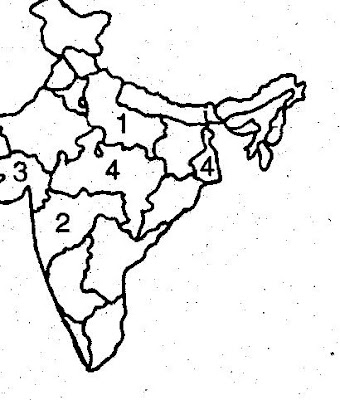
(a) 4, 2, 1, 3
(b) 4, 2, 3, 1
(c) 2, 4, 1, 3
(d) 2, 4, 3, 1
Ans. (b)
Sociology multiple choice questions test
SOCIOLOGY Solved Question paper
Q. 1. Who among the following is an advocate of the theory of Civil Legitimacy?
(a) John Locke
(b) Thomas Hobbes
(c) J.J. Rousseau
(d) Aristotle
Ans. (a)
Q. 2. Who among the following expressed the view that leadership necessarily required an element of voluntary submission on the part of the followers?
(a) Marx
(b) Weber
(c) Bottomore
(d) C. Wright Mills
Ans. (b)
Q. 3. The first person or set of persons to have used the term “Political Socialization’ was:
(a) Herbert Hayman
(b) Herbert Spencer
(c) Almord Powell
(d) Easton and Dennis
Ans. (a).
Q. 4. The status of organizations like the FICCI and CII in the political system is that of a/an:
(a) Economic institution
(b) Trade association
(c) Pressure group
(d) Interest group
Ans. (c)
Q. 5. . Which one of the following political movement mobilized its support on the basis of caste loyalties?
(a) Self-respect movement
(b) Naxalite movement
(c) Kisan movement
(d) Bodo movement
Ans. (a)
Q. 6. Which one of the following groups of thinkers belong to the linear view of social change?
(a) Comte, Pareto and Marx
(b) Pareto, Sorokin and Ogburn
(c) Comte, Ogburn and Marx
(d)Comte, Spencer and Pareto
Ans. (c)
Q. 7. Match List -I with List -II and select the correct answer by using the codes given below the lists:
List-I (Concept) List- II (Name of Thinker)
A. Sensate culture 1. Sorokin
B. Non-material culture 2. Ogburn
C. Forces of production 3. Marx
D. Instinct of workmanship 4. Veblen
Codes:
A B C D
(a) 1 2 3 4
(b) 1 2 4 3
(c) 2. 1 4 3
(d) 2 1 3 4
Ans. (a)
Q. 8. That society passes from the sacred to the secular stage is an idea expounded by:
(a) David Riseman
(b) Howard Becker
(c) Max Weber
(d) Karl Marx
Ans. (b)
Q. 9. Match List I with List II and select the correct answer by using the codes given below the lists:
List-I (Theory) List-II (Thinkers)
A. Circulation of elite 1. Sorokin
B. Limit theory of change 2. Ogburn
C. Evolutionary theory of change 3. Spencer
D. Dialectical theory of change 4. Marx
5. Pareto
Codes:
A B C D
(a) 2 1 4 3
(b) 5 1 3 4
(c) 5 4 1 2
(d) 2 1 3 4
Ans. (b)
Q. 10. Who among the following treated magic as a ‘Pseudoscience’?
(a) Taylor
(b) Frazer
(c) Morgan
(d) Malinowaski
Ans. (b)
Q. 11. According to the studies available, which one of the following has remained the most effective factor of social change amongst the Dalits?
(a) Reservation
(b) Social reforms
(c) Industrialization
(d) Collective action
Ans. (d)
Q. 12. According to Robert Blauner, “there is X between the level of technology used and alienation”. X stands for:
(a) An equal relationship
(b) An inverse relationship
(c) A positive relationship
(d) No relationship
Ans. (b)
Q. 13. Which one of the following tribes is associated with the ‘Bhagat Movement’?
(a) Seharia
(b) Bonda
(c) Bhil
(d) Mina
Ans. (c)
Q. 14. The maxim that a culture must be understood and evaluated on its own terms without reference to the values of another culture is known as:
(a) cultural hegemony
(b) cultural relativism
(c) cultural pluralism
(d) cultural specificity
Ans. (b)
Directions The following items consist of two statements, one labelled as ‘Assertion A’ and the other labelled as ‘Reason R’. You are to examine these two statements carefully and decide if the Assertion (A) and the Reason (R) are individually true and if so, whether the Reason is a correct explanation of the Assertion;
Select your answers to these items using the codes given below and mark your answer sheet accordingly.
Codes:
(a) Both A and R are true and R is the correct explanation of A
(b) Both A and R are true 6ut R is not the correct explanation of A
(c) A is true but R is false
(d) A is false but R is true
Q. 15. Assertion (A): Quality of life in Indian. cities is poor.
Reason (R): Large number of poor people live in Indian cities.
Ans. (a)
Q. 16. Assertion (A): Minorities in India feel insecure and alienated.
Reason (R): Minorities are ethnocentric.
Ans. (a)
Q. 17. Assertion (A): Muslims marriage, regulated by Muslims personal law, is a social character.
Reason (R): ‘Shariat’, the personal law of the Muslims, lacks in sacramental character.
Ans. (a)
Q. 18. Assertion (A): Concept of culture suggests bounded ness, homogeneity, coherence and stability.
Reason (R): Social reality is characterized by variability, inconsistencies and individual agency.
Ans. (b)
Q. 19. Assertion (A): In a caste system in which the accommodation lasts for a long time, the attitudes of members of the stratified groups get adjusted to the arrangement.
Reason (R): Accommodation is more than a purely external relationship and has become a conditioning force in shaping the social attitudes of persons.
Ans. (a)
Q. 20. Assertion (A): Commercial revolution was the main reason for the development of medieval cities
Reason (R): Colonization and conquests opened up the East to the Western market.
Ans. (b)
Q. 21. Assertion (A): Under the influence of mass-culture, people support the prevailing system of domination, against their own interest.
Reason (R): The mass-culture promotes apathy, resignation and acceptance of things as they are.
Ans. (a)
Q. 22. Assertion (A): Society always tries to come out with a solution to overcome a problem.
Reason (R): No society can afford to let a problem continue lest its unity and survival are endangered.
Ans. (a)
Q. 23. Assertion (A): For matrimonial relations, upper caste people are more class conscious than being caste conscious.
Reason (R): Economic status of the family is an important factor in the settlement of marriage.
Ans. (d)
Q. 24. Assertion (A): Nordic race is superior and creates superior culture.
Reason (R): A super-race does not create superior culture.
Ans. (d)
Q. 25. Assertion (A): In the opinion of Irawati Karve, caste is an extended kin-group.
Reason (R): All the members of a caste believe that they have descended from a common ancestor.
Ans. (a)
Q. 26. Assertion (A): It is not correct to assume that matrilineal families are consanguineal families.
Reason (R): Besides the consanguineal kins, the tharawad of Nayars consists of official relatives also.
Ans. (a)
Q. 27. Assertion (A): Marriage is a union between one man and one woman.
Reason(R): It establishes legitimacy of sex union and also the legitimacy of children.
Ans. (a)
Q. 28. Assertion (A): Territorial exogamy is not strictly confined to Northern kinship zone.
Reason (R): ‘Devara Okkalu’ of the Gangadikar Okkaligas of Karnataka was a form of territorial exogamy.
Ans. (d)
Q. 29. The modern industrial society is characterized by a shift of an increasing number of manual workers to the next higher stratum. This process is referred to as:
(a) sanskritization
(b) adaptation
(c) embourgeoisement
(d) class-homogenization
Ans. (c)
Q. 30. The book entitled “Politics of the Kula Ring” was written by:
(a) B. Malinowaski
(b) A.R. Redcliffe-Brown
(c) D.N. Majumdar
(d) J.PS. Uberoi
Ans. (b)
Q. 31. ‘Ad-hocracy’ is the system whereby there will be an administrative system with transient project teams, task forces and adhoc committees which would give dynamism and replace bureaucracies. This term was coined by:
(a) Peter Blau
(b) A. Etzioni
(c) Alvin Toffler
(d) Goldthorpe
Ans. (b)
Q. 32. Which of the following pairs are correctly matched?
1. Munda : Gitiora
2. Gonds : Ghotul
3. Naga : Rangbang
4. Trobriand Island : Bukumatula
Select the correct answer from the codes given below:
(a) 1, 2 and 3
(b) 1, 3 and 4
(c) 1, 2 and 4
(d) 2, 3 and 4
Ans. (c)
Q. 33. Match List- I with List -II and select the correct answer by using the codes given below the lists:
List-I List-II
(Tribe) (Features)
A. Bhils 1. Patriarchy
B. Todas 2. Matriarchy
C. Khasis 3. Polygyny
D. Oraons 4. Polyandry
Codes:
A B C D
(a) 3 4 1 2
(b) 3 4 2 1
(c) 4 3 2 1
(d) 4 3 1 2
Ans. (b)
Q. 34. Consider the following statements:
According to the Imperial Gazetteer of India a tribe is a:
1. collection of families with a common name
2. community using ancient means of production
3. community speaking a common dialect
4. community which is usually exogamous
5. community occupying a common territory
Select the correct answer from the codes given below:
(a) 1, 2, 3 and 4
(b) 2, 3 and 4
(c) l, 2 and 5
(d) 1, 3 and 5
Ans. (d)
Q. 35. Which one of the following Five Year Plans of India had human development as the main focus of planning?
(a) 4th
(b) 5th
(c) 7th
(d) 8th
Ans. (d)
Q. 36. Who among the following observed that the Chief Executives and the very rich are one and the same group in the U.S.A.?
(a) J.K. Gaibraith
(b) G. Myrdal
(c) C.W. Mills
(d) N. Smelser
Ans. (c)
Q. 37. Match List- I with List -II and select the correct answer by using the codes given below the lists:
List-I List-II
A. Habitat, Economy and Science 1. F.G. Bailey
B. Religion and the Rise of Capitalism 2. A.R. Desai
C. Peasant struggle in India 3. H. Tawney
D. Caste and the Economic Frontier 4. D. Forde
Codes:
A B C D
(a) 4 3 2 1
(b) 4 3 1 2
(c) 3 4 2 1
(d) 3 4 1 2
Ans. (a)
Q. 38. “Property is to be conceived in terms of the control of man over things, a control which is recognized by the society, more or less permanent and. exclusive.” According to:
(a) L.H. Morgan
(b) R.H. Lowie
(c) L.T. Hobhouse
(d) Adam Smith
Ans. (c)
Q. 39. According to Marx,. which .of the following are moments of man’s action on Nature?
1.Labour
2. Alienation
3. Social relations of production
4. Anomie
5. Social consciousness
Select the correct answer from the codes given below:
(a) 1, 2 and 5
(b) 1, 3 and 5
(c) 1, 4 and 5
(d) 2, 3 and 4
Ans. (b)
Q. 40. With whose name would one associate the study of the economy of Trobriand islanders?
(a) J.P.S. Uberoi
(b) E. Evans Pritchard
(c) B. Malinowaski
(d) R. Fifth
Ans. (c)
Q. 41. Consider the following States:
1. West Bengal
2. Rajasthan
3. Karnataka
4. Mahrashtra
The correct sequence of these states in descending order of their population (as per 1991 Census) is:
(a) l, 4, 2, 3
(b) l, 4, 3, 2
(c) 4, 1, 2, 3
(d) 4, 1, 3, 2
Ans. (d)
Q. 42. The concept of ‘doubling time’ pertains to the study of:
(a) finance
(b) population
(c) environment
(d) parasitology
Ans. (b)
Q. 43. The major share of a city’s population growth in India is due to:
(a) migration
(b) natural growth
(c) redefinitions of municipal limits
(d) industrialization
Ans. (a)
Q. 44. According to Malthus, in the control of overpopulation famines represent an example of:
(a) preventive checks
(b) negative checks
(c) positive checks
(d) morbid checks
Ans. (c)
Q. 45. Which one of the following States has the lowest density of population as per 1991 Census?
(a) Arunachal Pradesh
(b) Sikkim
(c) Mizoram
(d) Manipur
Ans.(a)
Q. 46. Mahmood Mamdani regards high fertility patterns amongst the poor as:
(a) normal
(b) abnormal
(c) rational
(d) irrtiona1
Ans. (c)
Q. 47. The first synchronic all India Census was organized in the year:
(a) 1871
(b) 1872
(c) 1901
(d) 1951
Ans. (b)
Q. 48. Consider the following States:
1. Kerala
2. Uttar Pradesh
3. Madhya Pradesh
4. Punjab
The correct sequence of these states in descending order in terms of sex-ratios (females per thousand males as per 1991 Census) of their population is:
(a) 3, 1, 2, 4
(b) 3, 1, 4, 2
(c) 1, 3, 2, 4
(d) 1, 3, 4, 2
Ans. (d)
Q. 49. Which one of the following is the correct arrangement of the State marked in the given map in terms of ascending order of the levels of urbanization?

(a) 2, 1, 3, 4
(c) 1, 2, 3, 4
(b) 2, 1, 4, 3
(d) l, 2, 4, 3
Ans. (d)
Q. 50. The correct sequence in descending order of the total population of Scheduled Tribes in the States marked on the map is:

(a) 4, 2, 1, 3
(b) 4, 2, 3, 1
(c) 2, 4, 1, 3
(d) 2, 4, 3, 1
Ans. (b)
Tuesday, May 3, 2011
Sociology Assertion Reason Questions For UPSC Exam
Sociology Assertion Reason Questions For UPSC Exa
Free Sociology Solved Reasoning Questions For UPSC Exams
Sociology practice paper for UPSC IAS Exam
Directions: The following items consist of. two statements, one labelled as ‘Assertion A’ and the other labelled as ‘Reason R ’. You are to examine these two statements carefully and decide if the Assertion (A) and the Reason (R) are individually true and if so whether the Reason is a correct explanation of the Assertion.
Select your answers to these items using the codes given below and mark your. answer sheet accordingly.
In the context of the above two statements, which one of the following is correct?
(a) Both A and R are true and R is the correct explanation of A
(b) Both A and R are true, but R is not the. correct explanation of A
(e) A is true, but R is false
(d) A is false, but R is true
Q. 1. Assertion (A): Protests by Scheduled Castes against the practice of Untouchability and atrocities have increased.
Reason (R): Their action have stirred the government machinery to enforce. law and order strictly.
Ans. (d)
Q. 2. Assertion (A): In pre-independence India, backward classes movement was never strong enough to affect the whole country.
Reason (R): The various backward classes had serious internal differences and could never work together.
Ans. (a)
Q. 3. Assertion (A): The Telangana Movement is one of the important militant peasant movements in India.
Reason (R): Indian National Con gave it effective leadership.
Ans. (a)
Q. 4. Assertion (A): The higher the job opportunities for female population in the paid labour market, the higher the rate of acceptance of family planning.
Reason (R): Opportunity and cost of a child is directly proportional to the employment status of mother.
Ans. (a)
Q. 5. Assertion (A): cording to the World Health Organization (WHO), in 1993, there were 16.5 million deaths due to infectious disease world wide.
Reason (R): Urbanization without health planning leads to the spread of diseases.
Ans. (a)
Q. 6. Assertion (A): Life-style determines life chances.
Reason (R): The class position of the individuals enhances or diminishes his life changes.
Ans. (a)
Q. 7. Assertion (A): Social mobility is the movement of individuals or groups from one social stratum to another.
Reason (R): The degree to which systems of stratification are open or closed depends on the extent of social mobility.
Ans. (a)
Q. 8. Assertion (A): Traditionally, a lower caste adopted the life-style of the dominant caste in the process of sanskritization.
Reason (R): Adaption of the life-style of the dominant caste usually symbolized a caste of upward mobility within the caste system.
Ans. (b)
Q. 9. Assertion (A): There is a considerable ethno linguistic diversity in India.
Reason (R): This prohibits equal opportunity.
Ans. (c)
Q. 10. Assertion (A): Most of the time the urban individual participates and fulfills his needs in secondary groups.
Reason (R): The primary groups have ceased to exist in modem societies.
Ans. (c)
Q. 11. Assertion (A): Cities are the confluence of races, cultures and peoples.
Reason (R): Cities are centers of innovations.
Ans. (b)
Q. 12. Assertion (A): According to Mallet, automation will revitalize trade union movement.
Reason (R): Automation integrates the working class into the structure of capitalist society.
Ans. (a)
Q. 13. Assertion (A): In order to survive, an authoritarian state resorts to repression, permanent mobilization and manipulation.
Reason (R): In an authoritarian state, the bureaucratic apparatus becomes responsive to the needs of the masses.
Ans. (b)
Q. 14. Assertion (A): The culture of the dominant class controls the dominant meanings.
Reason (R): The structure of relations between classes perpetuates itself by reproducing its characteristics in the domain of culture.
Ans. (c)
Q. 15. Assertion (A): Modernization goes hand in hand with education, mass communication, urbanization and political participation.
Reason (R): Dominance of the cultural influences from the West changes traditions elsewhere.
Ans. (b)
Q. 16. Assertion (A): In village India, factions are hardly V ever based on caste.
Reason (R): Inspite of changes in the actions, strategies and rules of the game, clash of personal interests is the root cause of factionalism.
Ans. (b)
Q. 17. Assertion (A): Kin terms are ‘role terms’.
Reason (R): Kin terms designate a biological as well as a social relationship.
Ans. (d)
Q. 18. Assertion (A): The State promotes, with special care, the educational and economic interests of the Scheduled Castes and the Scheduled Tribes.
Reason (R): Protection V from exploitation and promotion of social justice for the weaker and under privileged sections are among the primary functions of the Welfare State.
Ans. (a)
Q. 19. Assertion (A): Women in India today enjoy equal opportunities with men in all the fields.
Reason (R): The Constitution of India prohibits any kind of discrimination against women.
Ans. (a)
Q. 20. Assertion (A): The policy of protective discrimination adopted by Government of India, after independence, for Scheduled Castes/Tribes has become highly controversial today.
Reason (R): The reservations for SCs/STs in educational institutions and occupational fields have narrowed the gap between these castes on the one hand and higher castes on the other.
Ans. (c)
Free Sociology Solved Reasoning Questions For UPSC Exams
Sociology practice paper for UPSC IAS Exam
Directions: The following items consist of. two statements, one labelled as ‘Assertion A’ and the other labelled as ‘Reason R ’. You are to examine these two statements carefully and decide if the Assertion (A) and the Reason (R) are individually true and if so whether the Reason is a correct explanation of the Assertion.
Select your answers to these items using the codes given below and mark your. answer sheet accordingly.
In the context of the above two statements, which one of the following is correct?
(a) Both A and R are true and R is the correct explanation of A
(b) Both A and R are true, but R is not the. correct explanation of A
(e) A is true, but R is false
(d) A is false, but R is true
Q. 1. Assertion (A): Protests by Scheduled Castes against the practice of Untouchability and atrocities have increased.
Reason (R): Their action have stirred the government machinery to enforce. law and order strictly.
Ans. (d)
Q. 2. Assertion (A): In pre-independence India, backward classes movement was never strong enough to affect the whole country.
Reason (R): The various backward classes had serious internal differences and could never work together.
Ans. (a)
Q. 3. Assertion (A): The Telangana Movement is one of the important militant peasant movements in India.
Reason (R): Indian National Con gave it effective leadership.
Ans. (a)
Q. 4. Assertion (A): The higher the job opportunities for female population in the paid labour market, the higher the rate of acceptance of family planning.
Reason (R): Opportunity and cost of a child is directly proportional to the employment status of mother.
Ans. (a)
Q. 5. Assertion (A): cording to the World Health Organization (WHO), in 1993, there were 16.5 million deaths due to infectious disease world wide.
Reason (R): Urbanization without health planning leads to the spread of diseases.
Ans. (a)
Q. 6. Assertion (A): Life-style determines life chances.
Reason (R): The class position of the individuals enhances or diminishes his life changes.
Ans. (a)
Q. 7. Assertion (A): Social mobility is the movement of individuals or groups from one social stratum to another.
Reason (R): The degree to which systems of stratification are open or closed depends on the extent of social mobility.
Ans. (a)
Q. 8. Assertion (A): Traditionally, a lower caste adopted the life-style of the dominant caste in the process of sanskritization.
Reason (R): Adaption of the life-style of the dominant caste usually symbolized a caste of upward mobility within the caste system.
Ans. (b)
Q. 9. Assertion (A): There is a considerable ethno linguistic diversity in India.
Reason (R): This prohibits equal opportunity.
Ans. (c)
Q. 10. Assertion (A): Most of the time the urban individual participates and fulfills his needs in secondary groups.
Reason (R): The primary groups have ceased to exist in modem societies.
Ans. (c)
Q. 11. Assertion (A): Cities are the confluence of races, cultures and peoples.
Reason (R): Cities are centers of innovations.
Ans. (b)
Q. 12. Assertion (A): According to Mallet, automation will revitalize trade union movement.
Reason (R): Automation integrates the working class into the structure of capitalist society.
Ans. (a)
Q. 13. Assertion (A): In order to survive, an authoritarian state resorts to repression, permanent mobilization and manipulation.
Reason (R): In an authoritarian state, the bureaucratic apparatus becomes responsive to the needs of the masses.
Ans. (b)
Q. 14. Assertion (A): The culture of the dominant class controls the dominant meanings.
Reason (R): The structure of relations between classes perpetuates itself by reproducing its characteristics in the domain of culture.
Ans. (c)
Q. 15. Assertion (A): Modernization goes hand in hand with education, mass communication, urbanization and political participation.
Reason (R): Dominance of the cultural influences from the West changes traditions elsewhere.
Ans. (b)
Q. 16. Assertion (A): In village India, factions are hardly V ever based on caste.
Reason (R): Inspite of changes in the actions, strategies and rules of the game, clash of personal interests is the root cause of factionalism.
Ans. (b)
Q. 17. Assertion (A): Kin terms are ‘role terms’.
Reason (R): Kin terms designate a biological as well as a social relationship.
Ans. (d)
Q. 18. Assertion (A): The State promotes, with special care, the educational and economic interests of the Scheduled Castes and the Scheduled Tribes.
Reason (R): Protection V from exploitation and promotion of social justice for the weaker and under privileged sections are among the primary functions of the Welfare State.
Ans. (a)
Q. 19. Assertion (A): Women in India today enjoy equal opportunities with men in all the fields.
Reason (R): The Constitution of India prohibits any kind of discrimination against women.
Ans. (a)
Q. 20. Assertion (A): The policy of protective discrimination adopted by Government of India, after independence, for Scheduled Castes/Tribes has become highly controversial today.
Reason (R): The reservations for SCs/STs in educational institutions and occupational fields have narrowed the gap between these castes on the one hand and higher castes on the other.
Ans. (c)
Sociology MCQ Test
Sociology MCQ Test
Sociology Multiple Choice Quiz for exams
Sociology Model Test paper practice paper MCQ
Sociology Multiple Choice Quiz for exams
Sociology Model Test paper practice paper MCQ
Q. 1. A kibbutzim is:
(a) A tribal dance
(b) Community of economically equal families
(c) Garo term for extended family
(d) A religious sect of Mexico
Ans. (b)
Q. 2. The term Phratry refers to:
(a) Clustering of several clans into exogamous blocks
(b) Grouping of nuclear families in a common household
(c) Followers of animistic religion
(d) A dyad of Kula exchange partners
Ans. (a)
Q. 3. Which one of the following kinship terms indicates that father’s sisters is given greater importance than the mother?
(a) Amitate
(b) Avunculate
(c) Couvade
(d) Teknonymy
Ans. (a)
Q. 4. Which one of the following pairs of concept and definition is correctly matched?
(a) Exogamy : A rule requiring a person to choose a mate from the same
community
(b) Kin : People who are related either by blood or by marriage
(c) Endogamy : A rule requiring a person to marry outside his clan
(d) Patrilocal family: A family in which persons belong to their father’s lineage
Ans. (b)
Q. 5. In double descent system, one inherits property from:
(a) father’s matrilineal relatives and mother’s patrilineal relatives
(b) father’s patrilineal relatives and mother’s matrilineal relatives
(c) father’s patrilineal and matrilineal relatives
(d) mother’s matrilineal and patrilineal relatives
Ans. (b)
Q. 6. Practice of couvade refers to:
(a) promiscuity
(b) marriage with deceased wife’s sister
(c) impurity related to child birth
(d) simulation of pregnancy by the husband
Ans. (d)
Q. 7. There are three stages of development of Society, namely savagery, barbarism and civilization, according to:
(a) Darwin
(b) Morgan
(c) Spencer
(d) Bachofen
Ans. (b)
Q. 8. When cultural norms and values are transmitted from generation to generation, the process is called:
(a) cultural reproduction
(b) acculturation
(c) cultural diffusion
(d) cultural stimulation
Ans. (a)
Q. 9. Kroeber reported that an American Indian seeing the advantages of writing through contact with the whites
invented a system called syllabary with eighty-six symbols. This is an example of:
(a) discontinuous diffusion
(b) acculturation
(c) diffuseness
(d) stimulus diffusion
Ans. (c)
Q. 10. When a person believes that his culture is superior to other cultures, it is called
(a) ethnicity
(b) ethnocentrism
(c) cultural snobbery
(d) cultural relativism
Ans. (b)
Q. 11. Match List- I with List- II and select the correct answer by using the codes given below the lists:
List-I List-II
A. A daughter- in-law covers her head in the presence 1. Affectual
of her father-in-law
B. Action guided by ethical or aesthetic considerations 2. Wert rational
C. Actions arising out of spontaneous excitement 3. Zweck rational
D. A worker takes up a job in order to earn money with 4. Traditional
a view to meeting his needs
Codes:
A B C D
(a) 1 2 4 3
(b) 1 3 4 2
(e) 4 3 1 2
(d) 4 2 1 3
Ans. (d)
Q. 12. Role conflict arises when:
(a) An individual has to perform a number of roles simultaneously
(b) An individual has to perform a role which is socially not approved
(c) An individual has to perform two roles incompatible with one another
(d) The performance of a role pushes the individual into conflict with other individuals
Ans. (d)
Q. 13. The view that the tribal people should be allowed to retain their special characteristics while becoming a part of the mainstream, is known as:
(a) cultural relativism
(b) acculturation
(c) assimilation
(d) isolationism
Ans. (a)
Q. 14. Who among the following used the distinction between the repressive and the restitutive law as the basis for classifying societies?
(a) Max Weber
(b) Henri Maine
(c) Montesque
(d) Emile Durkheim
Ans. (a)
Q. 15. People who have similar incomes or are alike in other ways such as age, occupation and education are sociologically known as:
(a) Social categories
(b) quasi-groups
(c) social classes
(d) secondary groups
Ans. (c)
Q. 16. Consider the following groups:
1. A political party of one’s choice
2. One’s religion
3. One’s enemy
4. One’s favorite teacher
Among these groups, reference group(s) would include:
(a) 1, 2, 3 and 4
(b) 1, 3 and 4
(c) 2 and 4
(d) 2 alone
Ans. (c)
Q.17. Which one of the following does not represent ascribed status?
(a) A father
(b) A priest
(c) A brahmin
(d) An eta.
Ans. (a)
Q.18. The concept of recruitment roles was used by:
(a) Ralph Linton
(b) Talcott Parsons
(c) S.F. Nadel
(d) E. Hoffman
Ans. (d)
Q. 19. Which one of the following concepts implies that each social status involves not a single associated role but an array of roles?
(a) Multiple roles
(b) Status sequence
(c) Role-set
(d) Status-set
Ans. (c)
Q. 20. Which of the following characteristics are used by Maclver for defining a community?
1. Common religion
2. We feeling
3. Common language
4. Common territory
Select the correct answer from the codes given below:
(a) l, 2, 3 and 4
(b) l, 3 and 4
(c) 1, 2 and 3
(d) 2 and 4
Ans. (d)
Q. 21. Which of the following characteristics is/are related to Associations?
1. Definite ends
2. Specific interests
3. Close interaction
4. Fixed criteria for membership
Select the correct answer from the codes given below:
(a) l, 2 and 4
(b) l and 4
(c) 2 and 4
(d) 1, 2, 3 and 4
Ans. (a)
Q. 22. Who among the following maintains that Social
structure has nothing to do with empirical reality?
(a) C. Levi-Strauss
(b) Marion J. Levy
(c) Raymond Firth
(d) Evans Pritchard
Ans. (a)
Q23. An institution can be best described as a complex of:
(a) authority
(b) statuses
(c) roles
(d) procedures
Ans. (d)
Q. 24. Which one of the following statements is correct?
(a) ‘Social structure’ and ‘Social organization’ are two concepts denoting the same phenomenon
(b) Both ‘Social structure’ and ‘Social organization’ have no empirical referents
(c) An organization functions to accomplish a goal, while a structure does not
(d) Social structure has no relation with function
Ans. (a)
Q. 25. In a country, a separatist group has succeeded in seceding from the political union. This has raised the hopes of other centrifugal forces in the country. The possibility of the other centrifugal forces getting active would be the product of the separatist groups:
(a) manifest function
(b) latent function
(c) latent dysfunction
(d) manifest dysfunction
Ans. (c)
Q. 26. Match List- I with List- II and select the correct answer by using the codes given below the lists:
List-I List-II
A. Economy 1. Adaptation
B. Polity 2. Latency
C. Family 3. Goal attainment
D. Religion 4. Integration
Codes:
A B C D
(a) 1 3 2 4
(b) 3 1 4 2
(c) 1 3 4 2
(d) 3 1 2 4
Ans. (d)
Q27. Which one of the following is so important for the society that its violation calls for severe punishment?
(a) Customs
(c) Ideologies
(b) Mores
(d) Folkways
Ans. (b)
Q. 28. Which one of the following statements is true about ‘Mana’?
(a) The respect the father commands from his sons whose belief in ‘life after death’ tends to deity the father
(b) The sacred animal which is a symbol of deep group based sentiments and feelings
(c) A benign supernatural force that has no shape of its own but inhabits living or inanimate things
(d) A ritual that is arranged to felicitate a woman on her first pregnancy in a tribal society in North-East India
Ans. (c)
Q29. Which one of the following statements about deviance is not correct?
(a) Failure to conform to the customary norms of society
(b) A tendency on the part of an individual to behave in such away as to disturb the equilibrium of interactive process
(c) The concept of deviance is relative and not absolute
(d) Deviant behaviour is never socially useful
Ans. (d)
Q. 30. Which one of the following is the pre-requisite of social interaction?
(a) Face-to-face contact
(b) Harmony
(c) Physical contact
(d) Mutual orientation
Ans. (d)
Saturday, April 23, 2011
Sociology practice paper for UPSC Exams
Sociology practice paper for UPSC Exams
UPSC Civil Services Exam Previous Questions Sociology
UPSC EXAM INDIA: Model Question Paper Sociology
Q. 1. When a number of people ride in a life together, they usually stand facing the door. According to Anthony Giddens, this would be an example of:
(a) circumspection
(b) social distance
(c) politeness
(d) role performance
Ans. (b)
Q. 2. Which of the following are features of reference group behaviour?
1. Comparison
2. Appraisal
3. Emulation
4. Rejection
Select the correct answer from the codes given below:
(a) 1, 2 and 3
(b) l and 2
(c) 1, 3 and 4
(d) 3 and 4
Ans. (a)
Q. 3. When those who have risen above the lowest poverty levels indulge in civic unrest against the privileged, it is an expression of:
(a) Relative deprivation
(b) Social inequality
(c) Social mobility
(d) Factionalism
Ans. (b)
Q. 4. Which of the following are the characteristics of Society?
1. Territory
2. State
3; Individuals
4. System of interrelationships
5. Common culture
Select the correct answer from he codes given below:
(a) l, 2 and3
(b) 3, 4and5
(c) 2, 3, 4 and 5
(d) 1, 4 and 5
Ans. (b)
Q. 5. Which one of the following is the minimal pre-requisite of a social relationship?
(a) Physical contact
(b) Face-to-Face contact
(c) Mutual awareness
(d) Harmony
Ans. (c)
Q. 6. Which of the following are the characteristics of a modem urban society?
1. Organic solidarity
2. Mechanical solidarity
3. Strong collective consciousness
4. Weak collective consciousness
Select the correct answer from the codes given below:
(a) 2 and 3
(b) 2 and 4
(c) 1 and 3
(d) 1 and4
Ans. (d)
Q. 7. What does acculturation signify?
(a) Growing .up an internalizing the values and norms of one’s society
(b) Spread of a cultural element from the centre of origin to other societies
(c) Interchange of elements of culture between societies
(d) Incorporation of an element of culture from another culture, while retaining its identity
Ans. (d)
Q. 8. Who among the following identified and analyzed spatial and temporal dimensions of human interaction?
(a) Erving Goffman
(b) Robert A. Nisbet
(c) George Simmel
(d) Lewis Coser
Ans. (a)
Q. 9, The statement that ‘Indian culture is superior to Western culture’ is an example of:
(a) culture relativity
(b) ethnocentrism
(c) fundamentalism
(d) xenophobia
Ans. (b)
Q. 10. A group which does not allow a person to join similar other groups at one and the same time is called:
(a) disjunctive group
(b) in-group
(c) closed group
(d) congregate group
Ans. (a)
Q. 11. Who among the following developed the concept of ‘Primordial primary’ group?
(a) Edward Shils
(b) C.H. Cooley
(c) Erich Fromm
(d) George Homans
Ans. (d)
Q. 12. Which one of the following scholars has propounded that ‘command over resources and benefits’ is an organizing principle of large social structures?
(a) M. Fortes
(b) F. G. Bailey
(c) M. J. Levy
(d) S. F. Nadel
Ans. (d)
Q. 13. Who among the following has argued that a social structure cannot changc?
(a) Levi Bruhl
(b) Levi Strauss
(c) Pierre Bordien
(d) Raymend Aron
Ans. (b)
Q. 14. According to T. Parsons, the cardinal process in the formation and continuity of the social system is:
(a) goal attainment
(b) integration
(c) institutionalization
(d) adaptation
Ans. (c)
Q. 15. If a gang is involved in conflict with a rival gang, the intragroup conflict usually tends to:
(a) increase
(b) decrease
(d) remain unaffected
(c) disappear
Ans. (b)
Q. 16. “An association is a group of individuals united for specific purpose o purposes or held together by a recognized or sanctioned mode of procedure or behaviour”, according to :
(a) Maclver
(b) Glum and Gillin
(c) T. B. Bottomore
(d) Horton and Hunt
Ans. (b)
Q. 17. The term ‘relative deprivation’ was used originally by:
(a) Samuel A. Stouffer
(b) R.K. Merton
(c) Herbert Hyman
(d) K. Dais
Ans. (b)
Q. 18. What is the function of legal institutions in a society?
(a) Integration
(b) Adaptation
(c) Patterns maintenance
(d) Goal attainment
Ans. (c)
Q. 19. The process whereby various structural components of a social system are organized is called:
(a) assimilation
(b) integration
(c) cooperation
(d) accommodation
Ans. (b)
Q. 20. Match List- I with List -II and select the correct answer by using the codes given below the list:
List-I List-II
A. Ethics of common meanings 1. Conduct rituals
B. Ethics of individual responsibility 2. Norms, sanctions
C. Rational legal norms 3. Rigid principles
D. Magico-astrological pragmatism 4. Reflexive principles
Codes:
A B C D
(a) 4 3 1 2
(b) 3 4 2 1
(c) 4 3 2 1
(d) 3 4 1 2
Ans. (b)
Q. 21. “The community is the smallest territorial group that can embrace all aspects of social life,” according to:
(a) C.H. Cooley
(b) Kingsley Davis
(c) R.M. Maclver
(d) Harry H. Johnson
Ans. (b)
Q. 22. Promised rewards for compliance and threatened penalties for non-compliance with group expectations, is called:
(a) norms
(b) values
(c) sanctions
(d) mores
Ans. (c)
Q. 23. Which one of the following concepts correctly refers to the process by which cultural traits are transmitted from one society to another?
(a) Acculturation
(b) Universalisation
(c) Diffusion
(d) Assimilation
Ans. (c)
Q. 24. Who among the following defined ‘function’ as the contribution of a part to the maintenance and well being of the whole?
(a) Malinowaski
(b) Emile Durkheim
(c) Herbert Spencer
(d) Redcliffe Brown
Ans. (d)
Q. 25. A society in which cultural groups are not forced into assimilation, but are able to coexist with one another in mutual respect and with a fair share of the national resources is described as:
(a) a melting pot
(b) democratic
(c) pluralistic
(d) a mosaic
Ans. (c)
Q. 26. The assumption that every culture needs to be evaluated on its own terms, is the converse of:
(a) enculturation
(b) ethnocentrism
(c) domination
(d) minoritism
Ans. (b)
Q. 27. According to Parsons, for a social structure to persist it must reform which of the following functions?
1. Adaptation
2. Social action
3. Integration
4. Socialization
5. Goal attainment
6. Pattern maintenance
Select the correct answer from le codes given below:
(a) 1, 2, 3 and 4
(b) 2, 4, 5 and 6
(c) 1, 3, 5 and 6
(d) 1, 2, 4 and 5
Ans. (c)
Q. 28. Who among the following identified four major types of co-operation, that is, spontaneous, traditional, directed and contractual?
(a) Lewis Coser
(b) George Simmel
(c) Robert Nisbet
(d) George C. Homans
Ans. (a)
Q. 29. The view that social structure can be understood through roles, networks -and patterns was propounded by:
(a) S.F. Nadel
(b) Redcliffe Brown
(c) Talcott Parsons
(d) Herbert Spencer
Ans. (b)
Q. 30. Levirate means:
(a) a man marrying his wife’s sister while the wife is still alive
(b) a man marrying his wife’s sister after the death of his wife
(c) a woman marrying her husband’s brother while the husband is still alive
(d) a woman marrying her husband’s brother after the death of her husband
Ans. (d)
Q. 31. The Muslim community of Lakshadweep follows:
(a) matrilineal kinship and duolocal residence
(b) patriarchal kinship and neolocal residence
(c) matrilineal kinship and matrilocal residence
(d) patrilineal kinship and patrilocal residence
Ans. (a)
Q. 32. In which of the following communities is the marriage with one’s father’s sister’s daughter permitted?
(a) Coorgs and Marathas of northern Mahrashtra
(b) Marathas of Southern Mahrashtra and Okkaligas of Mysore (Karnataka)
(c) Marathas of entire Mahrashtra
(d) The Coorgs
Ans. (b)
Q. 33. Match List -I with List- II and select the correct answer by using the codes given below the lists:
List-I (Forms of Marriage) List-II (Tribes)
A. Marriage with mother’s brother 1. Todas
B. Fraternal polyandry 2. Tibetans
C. Both fraternal and non-fraternal polyandry 3. Coorgs
D. Levirate
4. Deshastha branch of Karnataka
Codes:
A B C D
(a) 1 4 2 3
(b) 4 1 2 3
(c) 4 1 3 2
(d) 1 4 3 2
Ans. (b)
Q. 34. ‘Dudhalutana’, as a form of cross cousin marriage prevalent among the:
(a) Gonds of Madhya Pradesh
(b) Santhals of Orissa
(c) Mundas of Chhota Nagpur
(d) Bhils of Rajasthan
Ans. (c)
Q. 35. Match List -I with List -II and select the correct answer by using the codes given below the lists:
List-I List-II
(Names of Family) (Tribes/Castes)
A. Gharawad 1 Coorgs
B. Okka 2. Nayars
C. Nok 3. Garos
D. Illam 4. Namboodiris
Codes:
A B C D
(a) 1 2 3 4
(b) 2 1 4 3
(c) 2 1 3 4
(d) 1 2 4 3
Ans. (c)
Q. 36. Marriage between single pairs, without involving the rights of exclusive cohabitation with each other is referred to as:
(a) Syndyasmian family
(b) Conjugal family
(c) Patriarchal family
(d) Promiscuous family
Ans. (a)
Q. 37. A ‘Tarwad’ is composed of a woman:
(a) her sons’ daughters, daughters’ daughters and sons
(b) her husband, her sons and sons’ daughter and sons
(c) her daughters, husbands and daughters’ daughters
(d) her son’s wives and daughters.
Ans. (b)
Q. 38. Match List -I with List -II and select the correct answer by using the codes given below the lists:
List-I List-II
(Terms of Kinship of Family) (Names of Sociologists who used them)
A. ‘Primary, secondary tertiary relatives’ 1. Parsons
B. Family of ‘procreation’ and family 2. Murdock
or ‘Orientation.’
C. ‘Joking-relationship’ 3. Redcliffe-Brown
D. Elementary family 4. Ogburn
Codes:
A B C D
(a) 1 2 4 3
(b) 2 1 3 4
(c) 1 2 3 4
(d) 2 1 4 3
Ans. (b)
Q. 39. Ritual kinship refers to:
(a) legally defined marriage relationship
(b) kins related to one another through blood
(c) kinship on the basis of functional relationship
(d) persons related to each other through rituals
Ans. (c)
Q. 40. Consider the following countries:
1. Pakistan
2. India
3. Indonesia
4. Bangladesh
The correct sequence of these countries in descending order in terms of the Muslim population is:
(a) 2, 3, 4, 1
(b) 3, 2, 4, 1
(c) 3, 2, 1, 4
(d) 2, 3, 1, 4
Q. 41. Which one of the following statements is not true?
(a) Social stratification means the same as social differentiation
(b) Social stratification is a particular from of ranking
(c) Gender inequality is a form of social stratification
(d) It is possible for social inequality to exist without social strata
Ans. (d)
Q. 42. Who among the following said that wealth increases in the same proportion as poverty?
(a) Marx
(b) Engels
(c) Weber
(d) Hegel
Ans. (a)
Q. 43. A person belonging to a Dalit caste gives up eating on vegetation food and adopts ritualistic worship. Which one of the following best describes this behaviour?
(a) Sanskritization
(b) Acculturation
(c) Enculturation
(d) Socialization
Ans. (a)
Q. 44. The concept of ‘respect of pollution’ was put forward by:
(a) L. Dumont
(b) Milton Singer
(c) S.C. Dubey
(d) E.B. Harper
Ans. (d)
Q. 45. Which one of the following was believed to represent the vertical unit of castes?
(a) Varna system
(b) Jajmani system
(c) Sanskritization
(d) Endogamy
Ans. (a)
Q. 46. Which of the following pairs are correctly matched?
1. Sanskritization : M.N. Srinivas
2. Little and Great Tradition : Meckim Marriott
3. Brahininization : Aiyappan
4. Parochialization : FG. Bailey
Select the correct answer from the codes given below:
(a) 2, 3 and 4
(b) l, 3 and 4
(c) 1, 2 and 4
(d) 1, 2 and 3
Ans. (d)
Q. 47. Which one of the following measures of fertility can be computed from date on sex and age alone from a single census?
(a) Child-woman ratio
(b) Total fertility rate
(c) Crude birth rate
(d) Age specific fertility rate
Ans. (a)
Q. 48. Which of the following pair(s) is/are correctly matched?
1. Variation in mortality with age represents a ‘J’ shaped curve : Characteristic of
developed countries
2. Concept of proximate variables of fertility : Contribution of
K. Davis and Judith
Blake
3. Variation in mortality represents a ‘U’ shaped curve : Characteristic of
underdeveloped
countries.
4. Net Reproduction Rate (N.R.R.) is equal to one (1) : A stagnant population.
Select the correct answer from the codes given below:
(a) 2 and 3
(b) 1 and 3
(c) 1, 2 and 4
(d) 4 alone
Ans.
Q. 49. Match List -I with List -II and select the correct answer by using the codes given below the lists:
List I List II
(Demographic features as per 1991 census) (States/UT)
A. Most populous state of India 1. Kerala
B. Ranked first among states in literacy 2. Nagaland
C. Had the highest population rate in 1981-91 decade 3. Uttar Pradesh
D. Had the highest population density in the country 4. Bihar
5. Delhi
Codes:
A B C D
(a) 1 2 3 4
(b) 3 1 2 5
(c) 4 1 5 3
(d) 3 5 2 4
Ans. (b)
Q. 50. The practice of levirate is found in:
(a) matrilineal societies
(b) patrilineal societies
(c) bi-lineal societies
(d) all the above societies
Ans. (b)
UPSC Civil Services Exam Previous Questions Sociology
UPSC EXAM INDIA: Model Question Paper Sociology
Q. 1. When a number of people ride in a life together, they usually stand facing the door. According to Anthony Giddens, this would be an example of:
(a) circumspection
(b) social distance
(c) politeness
(d) role performance
Ans. (b)
Q. 2. Which of the following are features of reference group behaviour?
1. Comparison
2. Appraisal
3. Emulation
4. Rejection
Select the correct answer from the codes given below:
(a) 1, 2 and 3
(b) l and 2
(c) 1, 3 and 4
(d) 3 and 4
Ans. (a)
Q. 3. When those who have risen above the lowest poverty levels indulge in civic unrest against the privileged, it is an expression of:
(a) Relative deprivation
(b) Social inequality
(c) Social mobility
(d) Factionalism
Ans. (b)
Q. 4. Which of the following are the characteristics of Society?
1. Territory
2. State
3; Individuals
4. System of interrelationships
5. Common culture
Select the correct answer from he codes given below:
(a) l, 2 and3
(b) 3, 4and5
(c) 2, 3, 4 and 5
(d) 1, 4 and 5
Ans. (b)
Q. 5. Which one of the following is the minimal pre-requisite of a social relationship?
(a) Physical contact
(b) Face-to-Face contact
(c) Mutual awareness
(d) Harmony
Ans. (c)
Q. 6. Which of the following are the characteristics of a modem urban society?
1. Organic solidarity
2. Mechanical solidarity
3. Strong collective consciousness
4. Weak collective consciousness
Select the correct answer from the codes given below:
(a) 2 and 3
(b) 2 and 4
(c) 1 and 3
(d) 1 and4
Ans. (d)
Q. 7. What does acculturation signify?
(a) Growing .up an internalizing the values and norms of one’s society
(b) Spread of a cultural element from the centre of origin to other societies
(c) Interchange of elements of culture between societies
(d) Incorporation of an element of culture from another culture, while retaining its identity
Ans. (d)
Q. 8. Who among the following identified and analyzed spatial and temporal dimensions of human interaction?
(a) Erving Goffman
(b) Robert A. Nisbet
(c) George Simmel
(d) Lewis Coser
Ans. (a)
Q. 9, The statement that ‘Indian culture is superior to Western culture’ is an example of:
(a) culture relativity
(b) ethnocentrism
(c) fundamentalism
(d) xenophobia
Ans. (b)
Q. 10. A group which does not allow a person to join similar other groups at one and the same time is called:
(a) disjunctive group
(b) in-group
(c) closed group
(d) congregate group
Ans. (a)
Q. 11. Who among the following developed the concept of ‘Primordial primary’ group?
(a) Edward Shils
(b) C.H. Cooley
(c) Erich Fromm
(d) George Homans
Ans. (d)
Q. 12. Which one of the following scholars has propounded that ‘command over resources and benefits’ is an organizing principle of large social structures?
(a) M. Fortes
(b) F. G. Bailey
(c) M. J. Levy
(d) S. F. Nadel
Ans. (d)
Q. 13. Who among the following has argued that a social structure cannot changc?
(a) Levi Bruhl
(b) Levi Strauss
(c) Pierre Bordien
(d) Raymend Aron
Ans. (b)
Q. 14. According to T. Parsons, the cardinal process in the formation and continuity of the social system is:
(a) goal attainment
(b) integration
(c) institutionalization
(d) adaptation
Ans. (c)
Q. 15. If a gang is involved in conflict with a rival gang, the intragroup conflict usually tends to:
(a) increase
(b) decrease
(d) remain unaffected
(c) disappear
Ans. (b)
Q. 16. “An association is a group of individuals united for specific purpose o purposes or held together by a recognized or sanctioned mode of procedure or behaviour”, according to :
(a) Maclver
(b) Glum and Gillin
(c) T. B. Bottomore
(d) Horton and Hunt
Ans. (b)
Q. 17. The term ‘relative deprivation’ was used originally by:
(a) Samuel A. Stouffer
(b) R.K. Merton
(c) Herbert Hyman
(d) K. Dais
Ans. (b)
Q. 18. What is the function of legal institutions in a society?
(a) Integration
(b) Adaptation
(c) Patterns maintenance
(d) Goal attainment
Ans. (c)
Q. 19. The process whereby various structural components of a social system are organized is called:
(a) assimilation
(b) integration
(c) cooperation
(d) accommodation
Ans. (b)
Q. 20. Match List- I with List -II and select the correct answer by using the codes given below the list:
List-I List-II
A. Ethics of common meanings 1. Conduct rituals
B. Ethics of individual responsibility 2. Norms, sanctions
C. Rational legal norms 3. Rigid principles
D. Magico-astrological pragmatism 4. Reflexive principles
Codes:
A B C D
(a) 4 3 1 2
(b) 3 4 2 1
(c) 4 3 2 1
(d) 3 4 1 2
Ans. (b)
Q. 21. “The community is the smallest territorial group that can embrace all aspects of social life,” according to:
(a) C.H. Cooley
(b) Kingsley Davis
(c) R.M. Maclver
(d) Harry H. Johnson
Ans. (b)
Q. 22. Promised rewards for compliance and threatened penalties for non-compliance with group expectations, is called:
(a) norms
(b) values
(c) sanctions
(d) mores
Ans. (c)
Q. 23. Which one of the following concepts correctly refers to the process by which cultural traits are transmitted from one society to another?
(a) Acculturation
(b) Universalisation
(c) Diffusion
(d) Assimilation
Ans. (c)
Q. 24. Who among the following defined ‘function’ as the contribution of a part to the maintenance and well being of the whole?
(a) Malinowaski
(b) Emile Durkheim
(c) Herbert Spencer
(d) Redcliffe Brown
Ans. (d)
Q. 25. A society in which cultural groups are not forced into assimilation, but are able to coexist with one another in mutual respect and with a fair share of the national resources is described as:
(a) a melting pot
(b) democratic
(c) pluralistic
(d) a mosaic
Ans. (c)
Q. 26. The assumption that every culture needs to be evaluated on its own terms, is the converse of:
(a) enculturation
(b) ethnocentrism
(c) domination
(d) minoritism
Ans. (b)
Q. 27. According to Parsons, for a social structure to persist it must reform which of the following functions?
1. Adaptation
2. Social action
3. Integration
4. Socialization
5. Goal attainment
6. Pattern maintenance
Select the correct answer from le codes given below:
(a) 1, 2, 3 and 4
(b) 2, 4, 5 and 6
(c) 1, 3, 5 and 6
(d) 1, 2, 4 and 5
Ans. (c)
Q. 28. Who among the following identified four major types of co-operation, that is, spontaneous, traditional, directed and contractual?
(a) Lewis Coser
(b) George Simmel
(c) Robert Nisbet
(d) George C. Homans
Ans. (a)
Q. 29. The view that social structure can be understood through roles, networks -and patterns was propounded by:
(a) S.F. Nadel
(b) Redcliffe Brown
(c) Talcott Parsons
(d) Herbert Spencer
Ans. (b)
Q. 30. Levirate means:
(a) a man marrying his wife’s sister while the wife is still alive
(b) a man marrying his wife’s sister after the death of his wife
(c) a woman marrying her husband’s brother while the husband is still alive
(d) a woman marrying her husband’s brother after the death of her husband
Ans. (d)
Q. 31. The Muslim community of Lakshadweep follows:
(a) matrilineal kinship and duolocal residence
(b) patriarchal kinship and neolocal residence
(c) matrilineal kinship and matrilocal residence
(d) patrilineal kinship and patrilocal residence
Ans. (a)
Q. 32. In which of the following communities is the marriage with one’s father’s sister’s daughter permitted?
(a) Coorgs and Marathas of northern Mahrashtra
(b) Marathas of Southern Mahrashtra and Okkaligas of Mysore (Karnataka)
(c) Marathas of entire Mahrashtra
(d) The Coorgs
Ans. (b)
Q. 33. Match List -I with List- II and select the correct answer by using the codes given below the lists:
List-I (Forms of Marriage) List-II (Tribes)
A. Marriage with mother’s brother 1. Todas
B. Fraternal polyandry 2. Tibetans
C. Both fraternal and non-fraternal polyandry 3. Coorgs
D. Levirate
4. Deshastha branch of Karnataka
Codes:
A B C D
(a) 1 4 2 3
(b) 4 1 2 3
(c) 4 1 3 2
(d) 1 4 3 2
Ans. (b)
Q. 34. ‘Dudhalutana’, as a form of cross cousin marriage prevalent among the:
(a) Gonds of Madhya Pradesh
(b) Santhals of Orissa
(c) Mundas of Chhota Nagpur
(d) Bhils of Rajasthan
Ans. (c)
Q. 35. Match List -I with List -II and select the correct answer by using the codes given below the lists:
List-I List-II
(Names of Family) (Tribes/Castes)
A. Gharawad 1 Coorgs
B. Okka 2. Nayars
C. Nok 3. Garos
D. Illam 4. Namboodiris
Codes:
A B C D
(a) 1 2 3 4
(b) 2 1 4 3
(c) 2 1 3 4
(d) 1 2 4 3
Ans. (c)
Q. 36. Marriage between single pairs, without involving the rights of exclusive cohabitation with each other is referred to as:
(a) Syndyasmian family
(b) Conjugal family
(c) Patriarchal family
(d) Promiscuous family
Ans. (a)
Q. 37. A ‘Tarwad’ is composed of a woman:
(a) her sons’ daughters, daughters’ daughters and sons
(b) her husband, her sons and sons’ daughter and sons
(c) her daughters, husbands and daughters’ daughters
(d) her son’s wives and daughters.
Ans. (b)
Q. 38. Match List -I with List -II and select the correct answer by using the codes given below the lists:
List-I List-II
(Terms of Kinship of Family) (Names of Sociologists who used them)
A. ‘Primary, secondary tertiary relatives’ 1. Parsons
B. Family of ‘procreation’ and family 2. Murdock
or ‘Orientation.’
C. ‘Joking-relationship’ 3. Redcliffe-Brown
D. Elementary family 4. Ogburn
Codes:
A B C D
(a) 1 2 4 3
(b) 2 1 3 4
(c) 1 2 3 4
(d) 2 1 4 3
Ans. (b)
Q. 39. Ritual kinship refers to:
(a) legally defined marriage relationship
(b) kins related to one another through blood
(c) kinship on the basis of functional relationship
(d) persons related to each other through rituals
Ans. (c)
Q. 40. Consider the following countries:
1. Pakistan
2. India
3. Indonesia
4. Bangladesh
The correct sequence of these countries in descending order in terms of the Muslim population is:
(a) 2, 3, 4, 1
(b) 3, 2, 4, 1
(c) 3, 2, 1, 4
(d) 2, 3, 1, 4
Q. 41. Which one of the following statements is not true?
(a) Social stratification means the same as social differentiation
(b) Social stratification is a particular from of ranking
(c) Gender inequality is a form of social stratification
(d) It is possible for social inequality to exist without social strata
Ans. (d)
Q. 42. Who among the following said that wealth increases in the same proportion as poverty?
(a) Marx
(b) Engels
(c) Weber
(d) Hegel
Ans. (a)
Q. 43. A person belonging to a Dalit caste gives up eating on vegetation food and adopts ritualistic worship. Which one of the following best describes this behaviour?
(a) Sanskritization
(b) Acculturation
(c) Enculturation
(d) Socialization
Ans. (a)
Q. 44. The concept of ‘respect of pollution’ was put forward by:
(a) L. Dumont
(b) Milton Singer
(c) S.C. Dubey
(d) E.B. Harper
Ans. (d)
Q. 45. Which one of the following was believed to represent the vertical unit of castes?
(a) Varna system
(b) Jajmani system
(c) Sanskritization
(d) Endogamy
Ans. (a)
Q. 46. Which of the following pairs are correctly matched?
1. Sanskritization : M.N. Srinivas
2. Little and Great Tradition : Meckim Marriott
3. Brahininization : Aiyappan
4. Parochialization : FG. Bailey
Select the correct answer from the codes given below:
(a) 2, 3 and 4
(b) l, 3 and 4
(c) 1, 2 and 4
(d) 1, 2 and 3
Ans. (d)
Q. 47. Which one of the following measures of fertility can be computed from date on sex and age alone from a single census?
(a) Child-woman ratio
(b) Total fertility rate
(c) Crude birth rate
(d) Age specific fertility rate
Ans. (a)
Q. 48. Which of the following pair(s) is/are correctly matched?
1. Variation in mortality with age represents a ‘J’ shaped curve : Characteristic of
developed countries
2. Concept of proximate variables of fertility : Contribution of
K. Davis and Judith
Blake
3. Variation in mortality represents a ‘U’ shaped curve : Characteristic of
underdeveloped
countries.
4. Net Reproduction Rate (N.R.R.) is equal to one (1) : A stagnant population.
Select the correct answer from the codes given below:
(a) 2 and 3
(b) 1 and 3
(c) 1, 2 and 4
(d) 4 alone
Ans.
Q. 49. Match List -I with List -II and select the correct answer by using the codes given below the lists:
List I List II
(Demographic features as per 1991 census) (States/UT)
A. Most populous state of India 1. Kerala
B. Ranked first among states in literacy 2. Nagaland
C. Had the highest population rate in 1981-91 decade 3. Uttar Pradesh
D. Had the highest population density in the country 4. Bihar
5. Delhi
Codes:
A B C D
(a) 1 2 3 4
(b) 3 1 2 5
(c) 4 1 5 3
(d) 3 5 2 4
Ans. (b)
Q. 50. The practice of levirate is found in:
(a) matrilineal societies
(b) patrilineal societies
(c) bi-lineal societies
(d) all the above societies
Ans. (b)
Subscribe to:
Posts (Atom)